TL;DR: The Short Answer
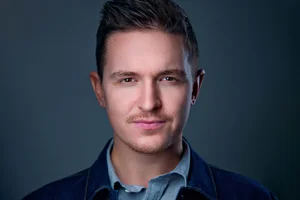
Great headshots aren't just about lighting and posing; they are about anticipating the "decisive moment." My background in sports photography taught me that capturing a genuine expression requires the same split-second timing as capturing a runner crossing the finish line. When you sit in front of my camera, you are negotiating with your own self-consciousness. My job is to use sports-level anticipation to click the shutter in the exact fraction of a second when you stop performing and start being real.
13 Miles of Human Emotion
I photographed a half-marathon in Chicago recently. You see a lot when you stand on a course with a camera for that long. You see people who look effortless, and you see people who look like they are negotiating with every single muscle in their body. You see smiling, grimacing, waving, limping, laughing, and people locking in to find one more gear near the end.
There is something very simple and very cool about watching that many people commit to something difficult and then actually do it. No shortcuts. No hiding. Just one foot in front of the other until the thing is done.
I went there to photograph it, but I left thinking about how much that environment mirrors what happens in my studio every day.
The Negotiation Behind the Lens
When you step in front of a camera for a professional headshot, you are entering a negotiation. You are negotiating with your own self-consciousness, trying to figure out how to look competent, approachable, and authoritative all at once. It is a performance, and usually, it is a stiff one.
In a marathon, there is no hiding. The physical exertion strips away the performance, leaving only raw, authentic emotion. In the studio, my job is to strip away that performance without making you run 13 miles. This is where the Misdirection Method comes in, but the method alone isn't enough. It requires the technical execution of a sports photographer.
Anticipating the Decisive Moment
In sports photography, 50% of the job is anticipation, and 90% of anticipation is experience . You don't wait for the play to happen and then react; if you do, you've already missed the shot. You have to predict the future. You have to know the rhythm of the game, the tendencies of the players, and the exact moment the action will peak.
This concept, often referred to as the "decisive moment," is just as critical in portraiture . When I am talking to a client, using misdirection to get them to relax, I am not just waiting for a smile. I am watching the micro-expressions. I am watching the tension leave their shoulders, the slight shift in their eyes, the moment they forget the camera is there.
That moment lasts for a fraction of a second. If I wait to see it before I click the shutter, I will capture the moment after the authentic expression, when the "professional mask" starts to slip back on. I have to anticipate the genuine reaction and time the shot perfectly.
Why Your Headshot Needs Sports-Level Timing
A lot of photographers can set up good lighting and tell you how to pose. But if they lack the timing to capture the space between the poses, you end up with a technically perfect photo of a fake expression.
When you hire a photographer with a sports background, you are hiring someone trained to capture fleeting reality. Here is how that translates to your headshot:
•Authenticity Over Perfection: We aren't looking for a frozen, plastic smile. We are looking for the split-second of genuine confidence that happens when you are actually engaged in a conversation.
•Efficiency: Because we know how to anticipate the moment, we don't need to take 1,000 photos hoping to get lucky. We know exactly what we are looking for and how to capture it.
•Trust Signals: Those split-second micro-expressions are what human brains and AI algorithms read as "trustworthy" and "competent." You can't fake them, and you can't capture them without precise timing.
Conclusion
Whether you are running a half-marathon or sitting for an executive portrait, the camera doesn't lie. It captures exactly what is happening in that fraction of a second. The difference between a generic headshot and a powerful personal brand asset is the photographer's ability to anticipate the moment you stop hiding. It is about timing, experience, and knowing exactly when to click the shutter.
About the Author
Cameron Southwood is the founder of Second City Headshots in Chicago. Drawing on his background in sports photography, Cameron uses advanced timing and anticipation techniques to capture authentic, high-impact executive portraits. He believes that the best headshots happen in the split-second when a subject stops performing and starts being real.
[1] Does anybody else feel like sports photography is 90% anticipation?